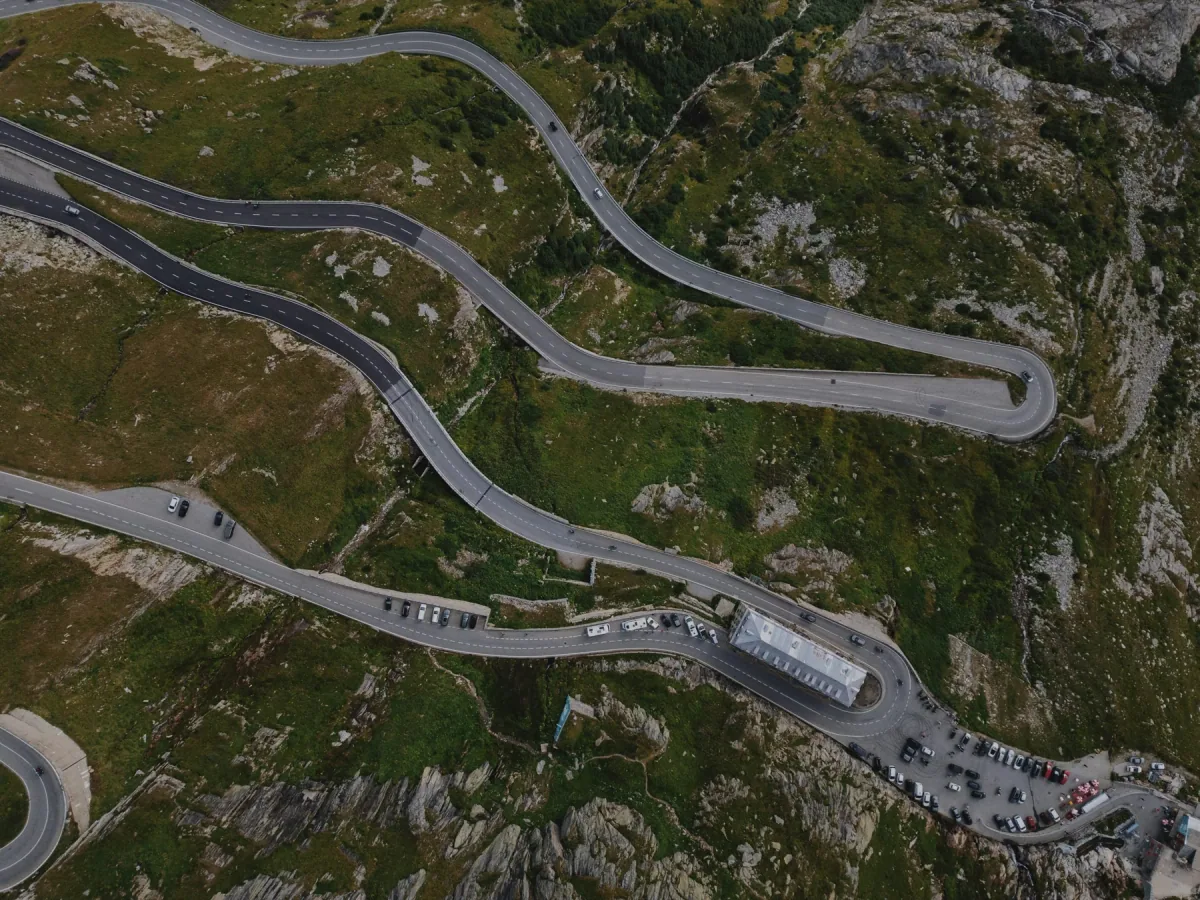
A flight into Zürich, a car collected in Milan, a few days in the mountains before Maranello: Switzerland can sit at almost any point in an Italian road trip. You can arrive from the north, work your way across the Alps and descend towards the lakes. You can just as easily start in Italy, head into the mountains and return by a different valley.
The distances on the map are encouragingly small. What matters is how you spend them. A motorway can move you across a large part of the country while a short succession of passes fills a day with bends, changing weather, coffee stops and reasons to get out of the car. Allow both kinds of day a place in the journey.
For Piloti, Switzerland belongs to the same travel world as the Italian lakes, the Dolomites and Motor Valley. Its particular pleasure is the transition: granite and reservoirs above Andermatt, the open valleys of the Engadin, then Italian voices and a table outside in Ticino. Give the Swiss part enough time to become a destination of its own.
This guide concentrates on the Alpine journey and its connections to Italy. The routes below are suggestions for shaping your trip, with room to change direction when the weather or your interests suggest something better.
01 / Switzerland
Switzerland at a glance
Think in valleys, nights and crossings
Choose a few places where you want to sleep, then connect them with roads you actually want to drive. Andermatt is particularly useful for the central passes. Lucerne adds a lakeside city and a transport museum. The Engadin gives you another mountain landscape and several ways south. Ticino can be the pause between the high roads and Italy.
These places are starting points with multiple possibilities. Zürich does not commit you to eastern Switzerland; Geneva does not commit you to staying in the west. Likewise, a Milan arrival can serve a substantial Swiss journey. Compare the flight, the car and the first night together before deciding where the holiday begins.
The practical essentials
| Detail | What it means for the trip |
|---|---|
| Currency | Budget in Swiss francs, CHF; check the currency on each quote. |
| Language | German, French, Italian and Romansh belong to different parts of the country. Italian becomes part of the journey before the Italian border. |
| High passes | Build flexibility into the dates. An attractive line on a map may be closed when you arrive. |
| Road charges | The motorway vignette is separate from possible charges for car trains and particular tunnels. |
| Time | Plan a pass day around daylight, stops and the weather, rather than kilometres alone. |
| The car | Width, visibility, luggage space and usable suspension matter throughout the trip. |
Spend where it changes the day
A second night near the passes can buy you more enjoyment than moving to a different hotel every evening. A garage with an easy ramp can make a modest hotel unusually useful. A good lunch close to the route can be a better choice than a celebrated restaurant that turns the afternoon into a deadline.
Set the budget for the whole stay: room, breakfast, garage, meals, fuel or charging, car hire and any transport tickets. Keep a little room for changing the plan. A wet afternoon becomes easier to enjoy when you can leave the car and take a train or visit a museum without feeling that the day has been wasted.
02 / Switzerland
Getting here and choosing the car
Airports that open up the journey
Start with the airports that offer a sensible flight from your home. These are useful gateways, not boundaries around where you should travel.
| Arrival | How to think about it |
|---|---|
| Zürich — ZRH | A flexible arrival for the central Alps, Graubünden or a wider journey across Switzerland before turning south. |
| Geneva — GVA | An arrival for Lake Geneva, Valais and the western Alps, with onward possibilities towards Italy and France. |
| Basel EuroAirport — BSL / MLH | Worth comparing for flights and cars, particularly when combining Switzerland with a journey from France or Germany. Check the rental sector. |
| Milan Malpensa — MXP | Start on the Italian side, then combine Ticino, the central passes or the Engadin with the rest of an Italian trip. |
| Milan Linate — LIN | Convenient when you want time in central Milan before collecting a car and heading towards the lakes and Switzerland. |
| Munich — MUC | Compare the car offering here if you want a longer Alpine approach, including eastern Switzerland, before Italy. |
An airport's location is only one part of the decision. An earlier arrival, a confirmed car or a straightforward return can be more useful than saving a little distance. Allow time after landing for the handover and a quiet first drive; a late flight does not need to end with a high pass in darkness.
Airport rental or a specialist car
A large rental company can be a practical choice for a trip lasting several days. Premium and sports categories vary by branch and date. Read the booking as a car category unless the supplier explicitly guarantees the model you want. A photograph of a Porsche does not by itself make the reservation a Porsche reservation.
Ask for the complete price, including mileage, extra drivers, cross-border use, delivery and return. Check the excess and the treatment of wheels, tyres, glass and the underside. These details matter when comparing an airport rental with a specialist that includes more individual preparation. SIXT's Swiss rental information is an example of why the actual country and vehicle terms need reading.
For an Italy-bound trip, get written permission for the countries you will enter and confirm where the car may be returned. Permission to drive into Italy and permission to leave the car there are separate questions. Your country of residence and the car's registration can also affect cross-border customs arrangements; ask the supplier to confirm these for your itinerary before paying. Swiss customs provides guidance on foreign vehicles, including particular restrictions for Swiss residents.
Geneva and Basel: choose the rental sector deliberately
Both airports have French and Swiss rental arrangements. Make sure the confirmation identifies the collection and return location, the contracting country and the equipment included. A cheaper headline price is useful only if the rest of the journey still works. Geneva also has conditions governing movement between its international and French sectors. Read the airport's instructions before organising a collection or return. Geneva car rental, EuroAirport collection and return.
The Munich or Milan option
Compare Munich and Milan alongside Swiss collection points if the car is an important part of the holiday. They let you turn the approach into part of the trip and may produce a more attractive combination of model, availability and total price. Savings are something to establish with quotations, rather than assume.
With Munich, allow the approach through Austria or southern Germany to have its own pace. With Milan, you can begin with city time, spend several nights in Switzerland and return to Italy. A return to the original rental branch may simplify the arrangement; compare that with the real cost of a one-way booking before fixing your flights.
Choose the car for the road you will use
A compact sports car or comfortable GT can make an excellent companion. Think about meeting a bus, entering a hotel garage and spending a wet motorway afternoon in the same car. A front-axle lift can help at some ramps, but it cannot solve every clearance problem. Check the car's instructions and the actual entrance.
Bring luggage that fits with the roof in the position you will use. Ask what tyres will be fitted for your travel dates. For an electric car, confirm a usable charging plan at your overnight stops and along the actual route; a hotel saying it has charging is the beginning of that conversation.
03 / Switzerland
Landscapes, seasons and the journey
Choose the season around the roads
For a first trip centred on several high passes, summer and early autumn offer the most realistic planning window. Exact openings vary from year to year and temporary closures can happen within the season. October can be beautiful, but it needs a route you can change without losing the point of the holiday.
Check the TCS pass portal for individual road status and restrictions, and MeteoSwiss weather warnings for the weather affecting the journey. Do that again on the morning you intend to cross. Sunshine at your hotel is not a report from the summit.
Andermatt and the central passes
Andermatt is a strong base when the driving itself is the focus. Stay for two nights and you can leave luggage at the hotel, choose the clearest day for a loop and return without a check-in deadline elsewhere. Nearby valleys also give you ways to reshape the day.
The classic sequence is Andermatt → Wassen → Susten → Innertkirchen → Grimsel → Gletsch → Furka → Realp → Andermatt. It can be reversed. Check every crossing, then choose direction around the conditions and the stops you want. Allow a full day with breaks, rather than treating the loop as something to fit between a flight and dinner in Italy.
Three passes, three different landscapes
Susten gives the day a succession of curves, galleries and open mountain views between Wassen and Innertkirchen. It works well as one part of a complete driving day; there is no need to make every viewpoint a stop.
Grimsel brings the reservoirs and exposed rock into the foreground. Stop in a proper parking area and walk far enough from the car to take in the scale of the landscape. The experience is as much about the engineered mountain environment as the road itself.
Furka adds tighter sections and the long views around Gletsch and Realp. It deserves patience when traffic meets on a narrow stretch. Do not let the wish for a familiar photograph determine where you stop. Check access and opening information separately for any attraction you intend to visit.
Piloti's suggestion is to give it one good day and leave an adjacent day flexible, rather than making three other fixed bookings depend on it.
Graubünden, the Engadin and the roads south
Eastern Switzerland gives you another way to build an Alpine chapter. Chur, the Julier approach and the Engadin can lead into nights around St. Moritz or Pontresina. There is room here for a mixture of driving, walking and long lunches, without adding a major pass to every day.
From the Engadin, Maloja leads into Val Bregaglia and towards Chiavenna, opening a journey towards Lake Como. Bernina leads through Val Poschiavo towards Tirano, where the Italian part can continue through Valtellina. These are choices about the places you want to reach as well as the roads themselves.
For a broader eastern journey, the material also connects Davos and Flüela with the Lower Engadin, Ofenpass and Val Müstair, then Italy around the Vinschgau. A Stelvio extension needs its own weather and road-status check. Choose a coherent arc; collecting every famous name can consume the time you wanted to spend in the places between them.
The western approach and Simplon
A journey from Geneva or Lake Geneva can follow Valais towards Brig, then cross the Simplon towards Domodossola. It connects naturally with an Italian stay around the western lakes or an onward journey into Piedmont. Switzerland Tourism describes the Brig–Domodossola crossing.
A road maintained for winter travel still needs a weather check. Think of the crossing as part of a wider route, with daylight and an arrival buffer, rather than a guarantee that conditions will suit any car on any day.
Three ways to shape the holiday
| Shape | Suggested sequence | Where to leave room |
|---|---|---|
| A central Alpine chapter | Arrive → Lucerne or Andermatt → a full pass day → Ticino → Italy | Add a second mountain night so you can choose the better day. |
| An eastern journey | Arrive → Chur or the Engadin → Maloja or Bernina → the Italian lakes or Valtellina | Choose the southbound exit around where you want to stay next. |
| A western approach | Arrive → Lake Geneva → Valais → Simplon → Domodossola and Italy | Allow time for the valley and a relaxed crossing day. |
These are editorial route sketches, not timed itineraries. They can be reversed, joined or shortened. After the lakes, set aside a separate travel day towards Modena, Maranello or Bologna. Fixed museum or factory appointments belong on days when arriving on time is easy.
04 / Switzerland
Life on the road
A different rhythm of driving
Enjoy the line of the road, the view and the way the car feels at ordinary speeds. Switzerland rewards concentration and patience. A bus, a cyclist or roadworks can change the rhythm instantly; leave the space to respond without urgency.
For ordinary passenger cars, the general limits are 120 km/h on motorways, 100 km/h on expressways, 80 km/h outside built-up areas and 50 km/h in built-up areas, unless signs specify otherwise. Serious speeding can have consequences well beyond a routine fine. Read the official Swiss speed guidance.
On descents, use the car's appropriate gear or drive setting and follow its operating guidance. Take a break when you need one. Passengers should be enjoying the journey too; a shorter day can be the better day.
The motorway vignette
The 2026 vignette costs CHF 40 and is valid from 1 December 2025 to 31 January 2027. There is no short-stay version. It is available as a sticker or an electronic vignette and is needed for the roads covered by the scheme. Ask whether the rental car already has one before buying it. Official vignette information and purchase link.
For an e-vignette, check the registration details carefully. Budget separately for any charged tunnel, car train or other transport in your plan. A pass road and its alternative route need not have the same cost or restrictions.
Weather, tyres and alternatives
Switzerland has no general blanket requirement to fit winter tyres, but that does not make summer tyres suitable for a snowy journey. Drivers must be able to control the vehicle; unsuitable equipment can have consequences. Match the car and tyres to the conditions you may encounter and follow local restrictions. The Swiss Federal Office of Energy explains the position in its tyre guidance.
Ask the rental company about tyres before booking an October sports-car trip. Do not rely on four-wheel drive as the answer to ice or snow. If conditions exceed what suits the car, take an appropriate alternative or stay another night.
When preparing a fallback, distinguish between a lower road, a motorway tunnel and a car train. They have different access points, charges and vehicle requirements. Check the operator's loading dimensions and guidance before assuming a very low car can use a train service comfortably.
Villages, access and parking
Reserve a garage when that is part of your hotel choice, and ask for its entrance address. Street restrictions still apply when a hotel is inside the historic centre. At a parking machine, read the hours, duration and payment instructions rather than relying on the colour of a bay alone.
Some mountain destinations need the car to stay behind. Make parking and the final train or cable-car leg part of the booking. Grosse Scheidegg should not appear in an ordinary private-car through route: Switzerland Tourism describes it as car-free, with PostBus access. Grosse Scheidegg access.
Fuel, charging and connectivity
Begin a mountain day with enough range to absorb a detour. Save the route and overnight addresses offline, and know where you can stop before the first climb. Check your mobile plan's Swiss roaming terms; coverage in an EU bundle should not be assumed to include Switzerland.
At the Italian border, keep the rental agreement and travel documents accessible. Leave room for a delay in the day's plan. Once across, use the Italian rules and payment arrangements; the Swiss vignette does not cover Italian motorway tolls.
05 / Switzerland
Staying and booking well
Choose a base that buys useful time
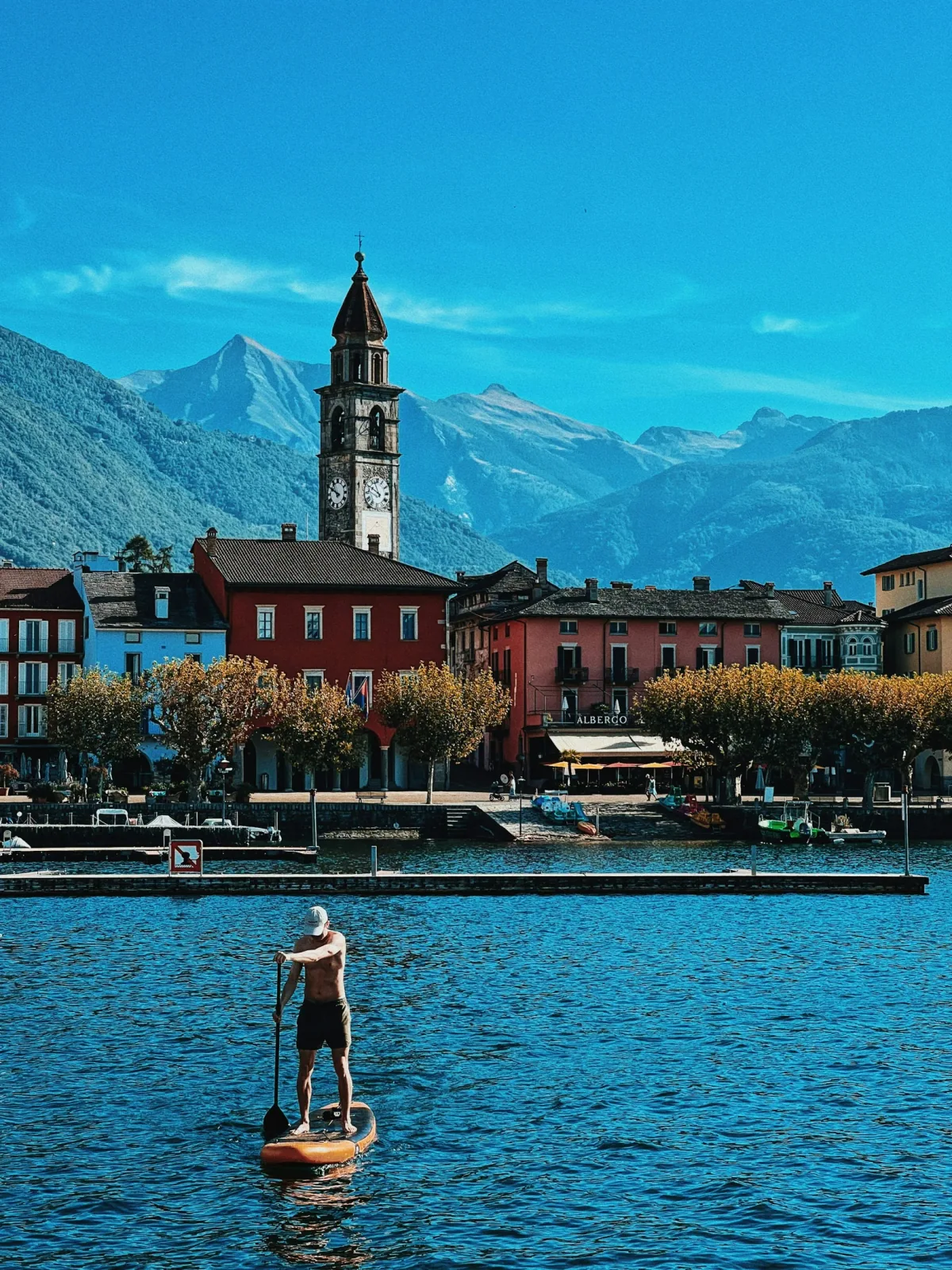
Andermatt suits a stay built around the central passes. Lucerne gives you a city evening, the lake and a wider choice of things to do away from the steering wheel. The Engadin suits a more easterly journey. Lugano, Locarno or Ascona can give the southern part a slower pace before Italy.
Pick the hotel for the whole stay. If a restaurant and an evening walk matter, being able to leave the car overnight may be more valuable than a room with the most dramatic view. If the next morning starts early, ask when breakfast is served and whether the garage will be accessible.
Ask about the last twenty metres
Send the hotel the car model and ask about ramp angles, width, turns and reserved spaces. A photograph of the garage entrance is often more useful than the word “parking” in the booking description. Check whether keys must be handed over and whether valet parking is optional.
For charging, ask about connector, power, access and whether the space is reserved or shared. For a specialist rental, confirm that the delivery team and hotel agree on where the handover will happen.
A museum day that belongs in this journey
Lucerne's Swiss Museum of Transport, Verkehrshaus, gives the car interest a specifically Swiss context. Its road-transport collection includes historic and modern vehicles and material on Monteverdi. Check the current programme and opening hours before visiting. Road Transport at Verkehrshaus.
It can anchor a quieter day or give you a worthwhile alternative when the mountain weather turns. Let it have time in the schedule instead of squeezing it between a full pass loop and a long drive south. Motor Valley remains the larger automotive destination further along the journey; Switzerland contributes its own roads, engineering and history.
Book the fixed parts, protect the flexible parts
Secure the car you care about, accommodation for busy dates and any appointment that cannot move. Keep the exact pass sequence flexible. Read cancellation terms with the route in mind: a non-refundable mountain stay and a weather-sensitive drive are a combination you should choose consciously.
Before an onward appointment in Italy, consider sleeping nearby the night before. That gives the Swiss chapter a proper ending and the next part a calm beginning.
06 / Switzerland
Food, drink and everyday life
Let the food change with the landscape
A journey across Switzerland moves through several food cultures. Take the opportunity to ask for something regional rather than repeating the same roadside meal. A bakery breakfast, a simple mountain lunch and a good dinner on foot can make a satisfying day without a succession of reservations.
In Ticino, look for a grotto, a traditional place to eat local food. Polenta, cheeses and cold meats are among the regional staples. Check opening days and whether the kitchen will be serving when you arrive. Ticino Tourism's introduction to grotti.
Make lunch part of the route
Ask the hotel to help with a realistic lunch stop, and check the kitchen hours directly if the timing matters. Carry water and something small to eat so a delayed crossing does not become an urgent search for a restaurant.
A long meal and several more hours of demanding driving are worth thinking about together. You can keep lunch light and make dinner the occasion, or shorten the afternoon and enjoy the table. Both can make a good holiday.
Paying and tipping
The national currency is the Swiss franc. Check the bill and the currency offered by a payment terminal, and compare any conversion with your card's terms. Keep a modest cash reserve for places where your preferred payment method is unavailable.
Tipping is optional in Switzerland. Rounding up or adding something for good service is a personal choice. Switzerland Tourism's tipping guidance.
Small courtesies travel well
Greet people when entering a small shop or restaurant, keep your reservation time and call if you are delayed. In a village, a quiet arrival is a considerate one. Leave the car in a proper space and let photographs fit around other people using the street.
Use the local language where you can, even for a greeting or thanks. Ask before photographing someone or the inside of a small business. These habits make the journey easier without requiring a performance of knowing every custom.
End the driving before the wine
Choose a dinner you can reach on foot, or arrange transport. That lets everyone enjoy the evening without trying to calculate a drink around the remaining road. After a day in the mountains, an unhurried meal and a short walk are often all the itinerary needs.
07 / Switzerland
Before you go
A short checklist that changes the trip
- Confirm the car, tyres, luggage capacity and the full rental terms for every country on the route.
- Check the vignette, insurance documents and any residence-related customs requirements with the supplier.
- Ask each hotel for the garage entrance, access instructions and charging arrangements if needed.
- Save the intended pass sequence and a practical alternative; recheck road status and weather each morning.
- Leave daylight and time for stops. Keep fixed Italian appointments clear of weather-dependent crossings.
- Check mobile roaming and save offline maps, booking details and contact numbers.
- Reserve meals that matter and check kitchen hours. Keep the evening drive out of the wine plan.
The morning decision
Start with the road status and forecast, then look at how everyone feels. Choose the full loop, one pass, a valley drive or a day out of the car. The point of preparing alternatives is to make that decision easy.
If the mountain chapter is followed by Italy, think one night ahead as well as one summit ahead. Know where the next comfortable stop is and which crossing gets you there under today's conditions.
Continue into Italy
The lakes can provide a pause between the mountains and Emilia-Romagna. From there, build the days around the visits you want in Modena, Maranello and Bologna. Leave space for meals and the everyday places around the museums; the journey becomes richer when the car is sometimes parked.
For a sense of the enthusiasm behind an Italian supercar journey, Peter Ternström's Gran Turismo is an inspiring book to take along. It is recommended here as reading, not as a source for this guide's practical advice. Use current operator and official information for the trip itself.
Switzerland can be the way into Italy, the return journey or a substantial stay between two Italian chapters. The strongest plan leaves enough time for the passes and enough freedom for the places that make you want to stop.